There is a number that should stop anyone working in Indian education in their tracks: approximately 13.2 million children between the ages of 5 and 17 are in child labour in India. A separate measure puts the number of out-of-school children aged 6 to 17 at 47.44 million, or nearly 17% of that entire age group.
These children are not missing school because schools do not exist. They are missing school because their families cannot absorb the cost of a child not working.
This is the detail that changes how you think about the problem. It is not an awareness gap. It is an economic calculation a family makes every single morning, weighing a day of wages against a day of class. A donated notebook does not change that calculation. A free pencil does not change it either. The decision was never about supplies in the first place.
What the research actually says
The most rigorous evidence on this comes from UNICEF Innocenti's research on child labour and schooling in India. Their findings are specific in a way that should reshape how interventions get designed: scholarships and cash transfers to families have been shown to reduce child labour, but only when the transfer amount is large enough to cover not just the cost of school, but the income the child would otherwise have earned. A scholarship that pays the fee but ignores the lost wages does not solve the underlying problem. It just shifts where the shortfall shows up.
The same research is clear that resources alone, in isolation, do not move the needle. Programmes that work combine two things: they address the real economic pressure on a household, and they help parents see a credible, concrete connection between staying in school and a better life for their child. Awareness campaigns that just tell parents "education matters" without addressing the income gap tend to fail. Programmes that do both, consistently work better.
Even children who are enrolled in school are often not in a position to learn. A child carrying the daily stress of poverty, instability, or family hardship does not absorb a lesson the same way a child without that weight does.
This is not a hypothesis. It shows up directly in classroom outcomes.

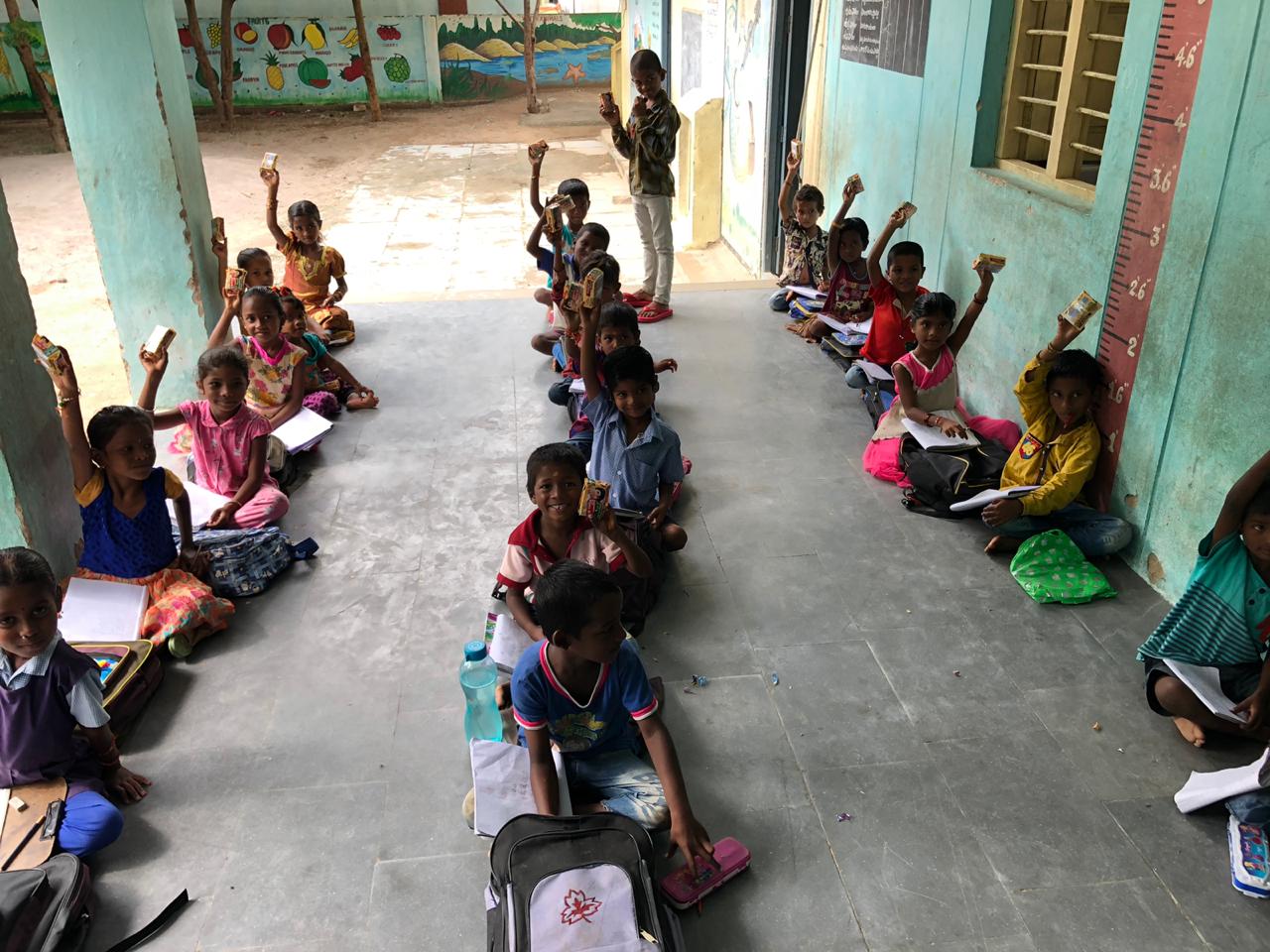
A Project Annapurna school in a tribal hamlet
What this actually looks like, right now
A few organisations working in India have built their entire model around this more complicated, more accurate understanding of the problem.
Touch A Life Foundation, based in Hyderabad, works specifically with underprivileged girls, and their approach is built on a detail that matters more than it sounds: their team does not just hand out scholarships. They run education camps and direct conversations with families, the same families who are weighing a daughter's school fees against the next month's expenses, and walk through the actual case for staying in school. Over a decade of operation, they have supported hundreds of girls through scholarships, mentorship, and career counselling, not as one-time interventions but as sustained relationships with the same students over years.
Labhya Foundation approaches a different part of the same problem. Their work is built on the recognition that a child from a low-income household carries real emotional weight into the classroom every day, and that weight directly limits how much they can actually learn, regardless of how good the teacher or the curriculum is. Rather than running a parallel programme outside the school system, Labhya partners directly with state governments to embed a daily social-emotional learning class into the existing public school day. Their Happiness Curriculum, co-created with the Delhi government, now reaches millions of children across multiple Indian states. The insight underneath it is simple and almost never acted on: you cannot fix a learning gap without first addressing the emotional gap that is causing it.

Children at an orphanage in one of the communities this work reaches
What a student campaign on this looks like done right
This is precisely the kind of cause Udayaa was built to support, and it is exactly why a current campaign on the platform is structured the way it is.

Samunnati, a student-led campaign supporting daily wage families and women across Hyderabad
Samunnati, a campaign founded by student changemaker Hasvi Muriki, did not start from a policy paper. It started on a mountain. Hasvi is a mountaineer, and on the trails she kept encountering children working instead of in school. Her first instinct, like most people's, was to tell them to go back to studying. It was only after she sat down with their parents and actually listened that she understood the real shape of the problem. These families were not unaware that education mattered. They had no margin to choose it.
That distinction is the entire thesis of this piece, arrived at independently by a student standing in front of the problem rather than reading about it.
Samunnati now funds annual school fees for high-potential children from daily wage families, so that a child's academic standing is not wasted because of financial circumstance.
It distributes books and supplies through a model called the Solo Care Initiative, built specifically to support one person at a time rather than mass distribution, because specific and dignified support holds up better than impersonal supply drops.
It runs leadership and entrepreneurship workshops for children at Smiles Orphanage, and vocational training for women in the same communities, addressing the household income side of the problem directly rather than treating it as someone else's job.
It is a campaign built by someone who did the listening first.
Where this leaves us
India does not have a shortage of good intentions directed at its out-of-school children. It has a shortage of interventions that are honest about what the actual barrier is. The barrier is rarely awareness. It is almost always income, and increasingly, it is also the emotional capacity a child has left over to learn after carrying the weight of their circumstances into a classroom.
The organisations getting this right are not the ones distributing the most supplies. They are the ones sitting with families long enough to understand why the supplies were never the problem.
You can support Samunnati's work directly through its campaign on Udayaa: udayaa.org/campaign/25